

🎯 Why Kratom Enthusiasts Choose Jack Botanicals
AKA Certified Excellence | Pure, Potent & Priced Right
🎁 YOUR EXCLUSIVE CODE: JACK30 Saves You 30%!
Unlock Your Discount →Mitragynine, the main active compound in kratom, has a terminal half-life of roughly 24 hours in most adults, according to pharmacokinetic research cited by the National Institutes of Health [1]. That single number explains almost everything people want to know when they ask how long does it take kratom to get out of your system, but the real answer depends on dose, frequency of use, body composition, and which test is being used to look for it. This article breaks down the half-life math, the detection windows for different drug tests, and the practical steps that actually shorten (or fail to shorten) clearance time.
Kratom is not a single substance moving through the body in one neat wave. It contains dozens of alkaloids, led by mitragynine and 7-hydroxymitragynine, each metabolized at a slightly different rate. That is part of why clearance estimates in the clinical literature vary more than people expect, and why two people taking the same kratom dosage can report very different timelines for feeling “clear.”
How Long Does Kratom Stay in Your System
For most occasional users, kratom is substantially cleared from the body within four to five days, though trace metabolites can sometimes be detected longer with sensitive lab testing. This estimate comes from applying standard half-life math (about five to six half-lives to reach near-total elimination) to mitragynine’s roughly 24-hour half-life [2].
✅ Discover What Makes Jack Botanicals Different
AKA Approved Standards | Lab-Verified Purity | Unmatched Customer Support
💎 READER EXCLUSIVE: JACK30 = 30% Off Storewide
Start Saving Today →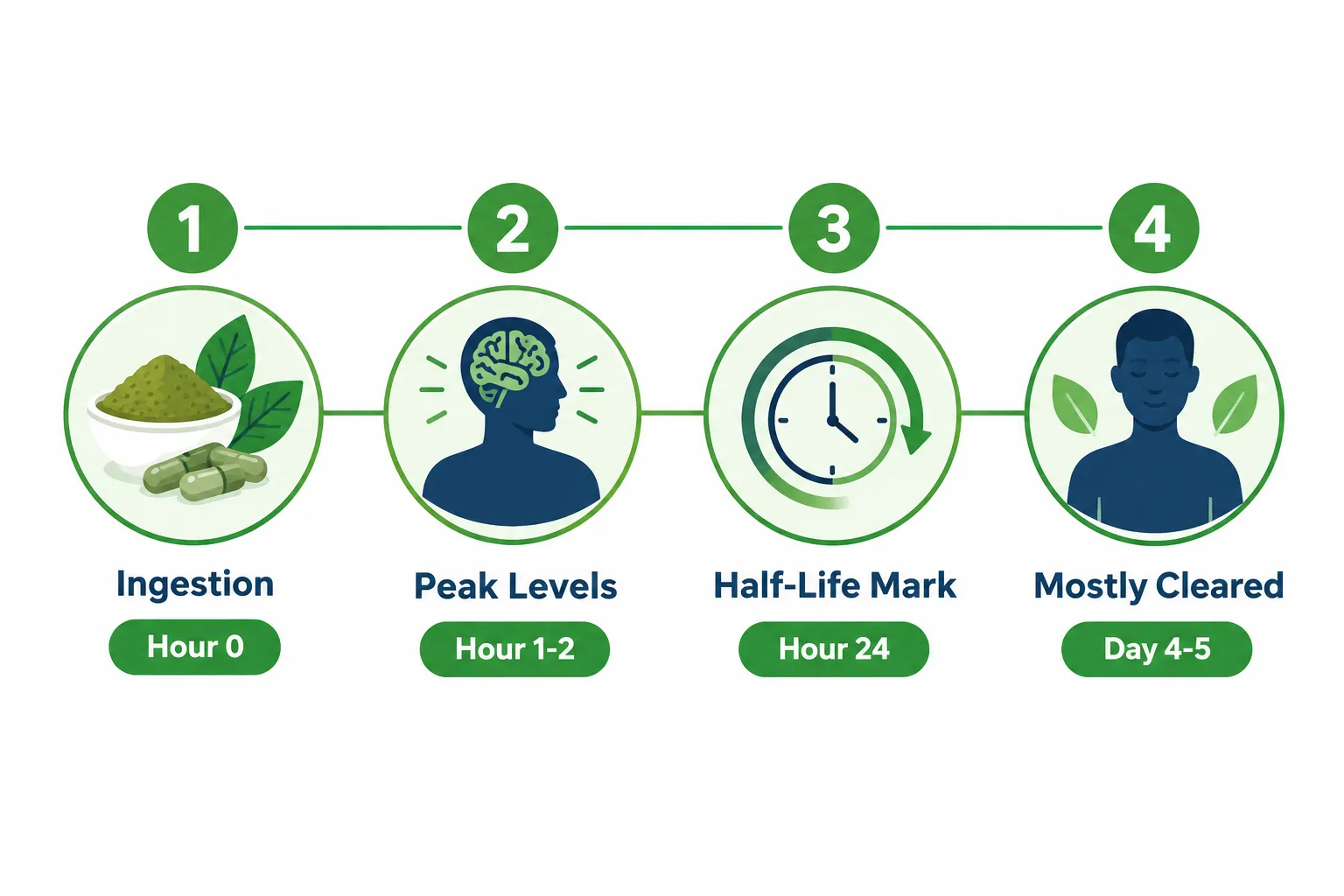
That timeline shifts depending on a few concrete factors:
- Dose size: A single 2-gram dose clears faster than a 6-gram dose taken the same day.
- Frequency: One-time or occasional use clears faster than daily use, because daily dosing builds up accumulated alkaloid levels.
- Metabolism and liver function: Slower liver metabolism extends clearance; this matters more for older adults or anyone with liver conditions.
- Hydration and body fat: Mitragynine is lipophilic, meaning it can linger slightly longer in people with higher body fat percentages.
Kratom elimination timeline overview
For a deeper breakdown of absorption and elimination curves, see how long kratom stays in your system, which covers the pharmacokinetic data in more detail.
Kratom Half-Life: How Long Does It Really Take to Clear
Kratom’s terminal half-life sits close to 24 hours for mitragynine based on human pharmacokinetic studies, though some newer research reports values ranging from about 17 to 25 hours depending on the study design [1]. A half-life is the time it takes for the body to eliminate half of the substance currently present, not the time to reach zero.
Using that figure, a standard rule of thumb applies: after five to six half-lives, a substance is considered mostly eliminated from plasma. For kratom, that works out to roughly five to six days for someone who takes a single dose and then stops. Daily users carry a different math problem entirely, because each new dose adds to whatever hasn’t cleared yet, which is covered later in this article.
Choose the longer end of that window if any of these apply: higher body fat, slower liver function, larger or more frequent doses, or use of extracts and concentrated products rather than raw kratom powder.
Why Does Kratom Take So Long to Leave Your System
Kratom takes longer to clear than some comparable plant alkaloids because it is processed through multiple liver enzyme pathways and produces several active metabolites, not just one. The liver converts mitragynine through CYP3A4 and CYP2D6 enzymes, generating byproducts that the kidneys then filter into urine over an extended period [1].
A few mechanisms drive this extended timeline:
- Multiple active alkaloids: Mitragynine and 7-hydroxymitragynine both require separate metabolic breakdown, which staggers full clearance.
- Enterohepatic recirculation: Some alkaloids get reabsorbed in the gut after initial liver processing, effectively extending their time in the body.
- Fat solubility: Lipophilic compounds store briefly in fatty tissue before being released back into the bloodstream for final processing.
Liver metabolism of kratom alkaloids
This is also why effects duration and elimination time are not the same thing. A dose might stop producing noticeable effects within a few hours, while trace alkaloids are still being metabolized well after that.
Does Kratom Show Up on a Drug Test
Standard workplace and medical drug panels, including the common five-panel and ten-panel tests, do not screen for kratom and will not detect it [7]. Kratom only shows up when a lab runs a specialized test designed specifically to look for mitragynine, which is uncommon outside of toxicology labs, specialty clinics, or targeted forensic testing.
That said, specialized testing is becoming more available, and detection windows vary significantly by sample type:
| Test type | Typical detection window | Notes |
|---|---|---|
| Urine | 1 to 7 days | Specialized tests can occasionally detect up to 9-14 days with heavy daily use [8] |
| Blood/Plasma | 24 to 48 hours | Sensitive assays may extend this slightly |
| Saliva | A few hours to 1-2 days | Short window; rarely used for kratom specifically |
| Hair | Theoretically weeks to months | Rarely tested in practice; window is largely theoretical |
Choose to expect the longer end of these windows if testing follows daily, high-dose use; choose the shorter end if it follows a single moderate dose taken days earlier. A common mistake is assuming a standard drug screen at a job or clinic checks for kratom at all, most do not [7].
Clinicians who monitor kratom use often describe a simpler practical rule: expect anywhere from “a couple of days to two weeks” depending on how often and how much someone used, rather than quoting one fixed number [9].
Kratom Clearance Time by Body Weight
Body weight and composition influence clearance speed, but the effect is modest compared to dose size and frequency of use. Because mitragynine is fat-soluble, people with higher body fat percentages may retain trace amounts slightly longer than leaner individuals taking the same dose [3].
Practical patterns reported in clinical and recovery literature include:
- Lower body weight with faster metabolism: clearance often lands near the shorter end of the typical window.
- Higher body weight or slower metabolic rate: clearance can extend by roughly 12 to 24 hours beyond the average estimate.
- Muscle mass and hydration status also play a secondary role, since better-hydrated individuals tend to process water-soluble metabolites more efficiently.
Body weight alone rarely changes the outcome by more than a day in either direction. Dose and frequency matter far more.
A warehouse shift supervisor who used two capsules of Maeng Da kratom most mornings before work once described getting flagged for a routine specialized panel at a new job. “I didn’t think twice about it because I’d never failed a standard test before,” the account read in a recovery forum thread. “Turns out the clinic ran an expanded panel that specifically screened for kratom, and it came back positive five days after my last dose.” The supervisor had used a moderate 4-gram dose daily for about three months, which meant accumulated alkaloid levels, not just the most recent dose, were still clearing. After switching to occasional use only on weekends, later tests came back clean within four days. The experience is a reminder that daily use changes clearance math more than most people expect, and that “I haven’t used in days” does not always mean fully clear on a specialized test.
Kratom Daily Use vs Occasional Use Clearance Time
Daily kratom use clears far more slowly than occasional use because each new dose is layered on top of alkaloids the body has not yet fully eliminated, creating accumulation rather than a simple one-time clearance curve. Occasional users (once or twice a week) typically reach near-total clearance in four to five days, while daily users may need nine to fourteen days before specialized testing shows a clean result [8].
Daily versus occasional use clearance comparison
Choose to plan for the longer timeline if use has been daily for more than two weeks, since steady-state accumulation behaves differently than a single dose working through the body. This distinction matters whether someone sources product locally or buys through an online kratom for sale vendor, since the clearance math is driven by use pattern, not where the product came from.
Kratom Clearance Estimator
Get a rough estimate of how many days kratom may take to clear based on use pattern and body weight. This is an educational estimate only, not a medical guarantee.
How to Get Kratom Out of Your System Faster
There is no proven method to dramatically speed up kratom’s metabolic clearance, but basic habits like hydration, light exercise, and avoiding further doses can support normal elimination and prevent adding more alkaloids to an already-processing system. No supplement, detox kit, or “flush” product has clinical evidence showing it accelerates mitragynine metabolism specifically [1].
What actually helps, based on general pharmacology principles:
- Stop further use immediately. Every new dose resets part of the clock, especially for daily users.
- Stay hydrated. Water supports kidney filtration of water-soluble metabolites, though it will not meaningfully shorten the liver-driven half-life itself.
- Light physical activity. Movement supports circulation and normal metabolic function without adding stress to the liver.
- Give the liver time. Since mitragynine clearance depends heavily on liver enzyme pathways, rest and avoiding alcohol or other liver-taxing substances supports normal processing speed.
A common mistake is assuming large amounts of water “dilute” a test result meaningfully for specialized panels; over-hydration can sometimes flag a sample as diluted rather than clean, which creates its own complications. Anyone tapering off regular use may benefit from reviewing safe tapering methods rather than stopping abruptly, since gradual reduction can ease the transition while the body clears accumulated alkaloids.
Dosage and expected effect range (approximate, informational only):
- 1-2g powder: mild energy lift, light focus boost, clears closer to the shorter end of the window
- 2-4g powder: balanced stimulation and calm, moderate pain relief, average clearance pace
- 4-6g powder: stronger sedation, deeper pain relief, slower subjective wind-down
- 6g+ or extract form: pronounced sedation, higher accumulation risk with repeat daily dosing
Kratom Withdrawal Timeline: How Long Does It Last
Kratom withdrawal symptoms typically begin within 6 to 12 hours of the last dose, peak around day 3 to 5, and substantially improve by day 7 to 10 for most regular users, though some lingering symptoms like mood changes or sleep disruption can extend to two weeks [4][9]. This timeline generally tracks with, but is slightly longer than, the physical clearance window described earlier in this article.
Kratom withdrawal stages over two weeks
Choose to expect a longer, more gradual withdrawal curve if use was daily, high-dose, or extended over several months. A full breakdown of symptom severity and day-by-day expectations is available in how long kratom withdrawal lasts, including guidance on when symptoms typically signal it’s time to seek medical support.
Does Kratom Strain or Form Change How Long It Stays in Your System
Strain and product form influence intensity and duration of effects more than they change the underlying half-life, but concentrated forms can extend practical clearance time because they deliver more alkaloid per dose. Red vein kratom strains like Red Bali, Red Borneo, and Red Maeng Da tend to carry higher 7-hydroxymitragynine ratios in some batches, which some users report feeling longer, while white vein and green vein kratom strains such as White Borneo, Green Malay, and Green Bali are generally reported as more stimulating with shorter perceived duration.
Form matters for total alkaloid exposure:
- Kratom powder and tea: Standard absorption rate; dosing is easiest to control and measure.
- Kratom capsules: Slightly delayed onset due to capsule dissolving, similar overall clearance to powder.
- Liquid kratom shots and extracts: Higher concentration per serving, which can mean more alkaloid load to metabolize and a longer practical clearance window.
- Kratom vape and gummies: Less standardized dosing makes clearance harder to predict consistently.
Sourcing matters too. Buying from reputable vendors rather than unverified best gas station kratom products reduces the risk of inconsistent alkaloid concentration, which otherwise makes clearance estimates far less reliable. Checking current kratom legal status in a given state is also worth doing before buying, since legality and product quality standards vary by location.
Kratom vs Other Substances: How Long in System
Kratom’s roughly 24-hour half-life places it closer to moderate-duration substances rather than fast-clearing stimulants or slow-clearing sedatives. The comparison below is for general context only and reflects typical ranges reported in clinical and toxicology sources [1][2].
| Substance | Approximate half-life | Typical urine detection window |
|---|---|---|
| Kratom (mitragynine) | ~24 hours | 1 to 7 days (up to 14 with heavy daily use) |
| Caffeine | 3-7 hours | Under 24 hours |
| Short-acting opioids | 2-4 hours | 1-3 days |
| Benzodiazepines (short-acting) | 6-24 hours | 1-4 days |
| Cannabis (occasional use) | 1-3 days (stored in fat) | 3-7 days (longer with chronic use) |
Choose to treat kratom clearance expectations as closer to a moderate-duration substance rather than something that clears in hours, and closer to the faster end of that spectrum compared to fat-stored compounds with long elimination tails.
Frequently Asked Questions
Kratom Clearance FAQ
Conclusion
The honest answer to how long does it take kratom to get out of your system is that it depends more on use pattern than any single fixed number. A single moderate dose typically clears within four to five days based on mitragynine’s roughly 24-hour half-life, while daily or high-dose use can extend meaningful clearance to one to two weeks, especially on specialized tests designed specifically to detect kratom [1][9]. Standard workplace drug panels almost never screen for it at all [7].
Anyone concerned about detection, withdrawal, or safe use going forward should focus on three practical steps: track actual dose and frequency honestly, avoid combining heavy daily use with any assumption that clearance will be fast, and consult a medical provider before tapering if use has been daily for an extended period. For strain-specific dosing guidance or vendor research before buying again, review where to buy bulk kratom sources with transparent lab testing, since product consistency makes future clearance estimates far more predictable.
References
[1] Nbk585120 – https://www.ncbi.nlm.nih.gov/books/NBK585120/
[2] Stay In System – https://greenhousetreatment.com/kratom/stay-in-system/
[3] How Long Does Kratom Stay In Your System – https://alpaswellnesscenters.org/how-long-does-kratom-stay-in-your-system/
[4] How Long Last – https://americanaddictioncenters.org/kratom/how-long-last
[7] Drug Test – https://kratom.org/guides/drug-test/
[8] How Long Does Kratom Stay In Your System – https://recovered.org/other/kratom/how-long-does-kratom-stay-in-your-system
[9] How Long Kratom Stay In Your System – https://pathwaysrecovery.com/blog/how-long-kratom-stay-in-your-system/
Avery Bennett is a cultural researcher and nature enthusiast with a special interest in the rituals and beliefs surrounding plant life. She has studied how communities across the globe have used the natural world as part of their daily customs and seasonal transitions. Avery’s approach to learning is experiential—visiting local gatherings, observing folk practices, and engaging with tradition keepers. She believes that every plant carries a story that reflects the resilience, spirituality, and creativity of the people who use it. Avery focuses on highlighting these stories through educational content that honors cultural legacy, promotes sustainability, and encourages respectful curiosity.
- Avery Bennett

- Avery Bennett

- Avery Bennett

- Avery Bennett

Caleb Foster is a self-described earth learner with a fascination for traditional living systems and the spiritual role of nature across cultures. He has participated in heritage walks, studied ancient texts, and spoken with keepers of tradition to understand the intersection of plants, ceremony, and identity. Caleb believes that learning from the past is essential to living more intentionally in the present. His interests include seasonal observances, indigenous land practices, and communal rituals rooted in nature. Caleb offers a perspective that respects origin stories and celebrates the many ways humans have engaged with the plant world for connection and meaning.
- Caleb Foster

- Caleb Foster

- Caleb Foster

- Caleb Foster


